Wednesday, 4 June 2014

Papel or Papeles Sellado


Old Tagalog as written by an "escribano" or scribe

Years before I caught on the "serious" collecting bug, I was collecting paper ephemera like papel sellado.  By serious, I meant collecting objects that moneyed collectors covet like santos figures and ceramics. Back then, I was eking out the life of the proletariat living from one paycheck to the next whereby my disposable income for such indulgences is limited by the price ceiling. I was a cheapskate scraping the crumbs of Ebay.ph. The only difference now is that I have a slightly bigger paycheck.

I was interested in anything Spanish colonial and papery. Papel sellado stood out as perfect collecting material.  And my goodness, the amount and quality being offered was spectacular- a lot were affordable and quite interesting.

I snapped up everything that I could lay my hands on (budget permitting), and soon I was able to amass two albums full of documents.  During that time, the supply was plenty and the demand weak. So I was happy.

A 1-page document for 1855.

My insights so far:

1.  During the Spanish rule, papel sellado was introduced as a means of increasing government revenue through taxation of official documents. It's like having a notary public, but in this case, if you want to make something official, you have to pay the government in order to document your claim.

2.  Papel sellado had a range of values- from the cheapest (pobres) to most expensive (ilustres)- meaning even the poor illiterate farmer can have his official document too.  And this face value is depicted in different allegorical illustrations and colors so as to differentiate the years they were published.  So a papel sellado done in 1887 would be different from 1888.

Pobres. The lowest value.

3.  In collecting them, the higher the face value means the higher is its catalog value. Perhaps it is because not a lot of ordinary people used them, so there were only a few pieces left. And only the rich like the friars could afford the high value ones. 

4.  Since the high value sellados were used by the educated and the rich, the language used was typically Castillan in flavor and the handwriting more refined.  The lower class values meanwhile were usually written in the vernacular. Remember that Tagalog was still a language limited to the environs of Manila (and not a national language), so sellados coming from Ilocos would have been written in Ilocano.

5.  Although collectors value the seal and the stamp more, the contents of the sellado, for me, has the greater appeal. If you love languages, you'll enjoy reading Old Tagalog with its use of c's instead of k's, the lyricism of the words. You shall discover also from these fine existing examples the evolution of the Filipino language and how much has changed in terms of orthography and grammar.

6.  They will make you appreciate our Spanish heritage more because through this you will discover the lives, the trade-goods, the geography of a people long gone.  And reading the 1st hand narrative is the best.

The dry seal
For the past couple of years, the prices climbed steadily the rate of which is pretty alarming. Good luck to you if you can find one that costs less than P500. Most sellers already are quoting prices from the Lehmann Catalog thereby jacking up the cost.  I find this quite horrendous.  Why?

1. Even though I find the reference extremely important in cataloging extant Philippine papel sellados, I find it disturbing that local and foreign dealers quickly quote the catalog prices as bible truths as if the prices were dictated by the "National Committee on the Collection of Papel Sellado."  Before, a 2-page 1-stamp papel sellado from 1880s would have a selling range between P300-500. Now, dealers would quote a similar item at a slightly lesser price than the catalog value regardless of the state of its preservation (wormholed, torn, etc.)
Ex. "(L-619) Rare item catalog value of $75 but I'm selling it for $40 (P1700)"

2.  The catalog was written as a guide for collectors and not as a means for jacking up the prices.  Dealers pounced on this fact because there was no previous guide to speak of, and they thought, "Aha! I've been selling papel sellados so low, now that someone has published catalog values of my items, I'll just follow them and jack up my prices."   It's frustrating for the collector because the increase in the prices are not based on market forces but rather solely on the "expert" opinion of one who has published the pioneering monograph. It's frustrating really.
Ex. One Ebay.ph seller has a penchant for quoting the Lehmann catalog per page, meaning if your document has four pages, expect the price to increase exponentially.

Until that time when demand will snowball to a point when collectors will buy even at catalog prices, only then they shall have that moral ascendancy to do so because right now, they all look like money-grubbing ignoramuses.  Imagine selling a worm-holed and stained document at catalog price.  It's ridiculous. Anyhow,  with the current demand limited to a handful of knowledgeable collectors, having such prices soaring through my budgetary roof is really a huge turn off.

It has nearly been a decade since the first catalog was published online.  We'll just have to wait and pounce on those with better prices and reject those sellers who think that having an obscure Spanish document is as valuable as having the map to the Yamashita treasure.

my mini-collection
Just in case you missed the link for the Lehmann Catalog: www.theipps.info/bibliography/Papeles_Catalog.pdf

Wednesday, 28 May 2014

Sell Your Wares @ Harringtons Lifestyle Auction


For those collectors who would like to dispose their ceramics, paintings, sculptures, furniture, collectibles, but do not know where, Harringtons may provide you with that venue.  They're inviting consignors for their next auction. At least here, no dealer will give you his rock bottom buyer's price and no seller will bite the bullet just to sell his/her collection.

Inviting consignors for the 2nd HARRINGTONS LIFESTYLE AUCTION to be held at Rockwell Tent, Makati City on July 26, 2014.

Please call 5486900 local 6906, 6962 or 6936 for more details.

News: Manila’s Antique Shops Seek Past Glory


They used to be among Manila’s top attractions, but antique and arts shops especially in the Malate and Ermita districts had lost much of their charm through the years, with the last few holdouts yearning  for the good old days of selling old stuff.

Wilfred delos Reyes of Gallery Deus, which sells religious antiques and tribal artworks on Padre Faura Street, recalled how business was so brisk especially in the 1980s despite the stiff competition among the shops.

Back then, “almost a hundred percent of the shops on Mabini Street were into antiques,” Delos Reyes said. “Now there are less than 10 left.”

His own gallery, for example, could make around P1.2 million in just two days during that period, “but today it is hard for us to earn even P100,000 a month.”

Many shops started relocating to other cities like Pasay and Makati in the late ’90s, when rent got more and more expensive in Manila, pedestrian-friendly streets gave way to squalor, and crimes went on the rise..... (click link to continue reading)


READ:  Manila’s antique shops seek old glory through urban renewal

One has to read in between the lines to note that the dwindling supply and the deterioration of the area contributed to the disappearance of the antique trade in Ermita.  Is it just a matter of time?

Wednesday, 29 January 2014

Santos Series 02: San Miguel


Last week, I chanced upon my in dealer's shop here in the Philippine city of Puerto Buenvivir, in the province of  Montemayor (of course, pseudonyms lang tayo dito) a nice vintage santo.  Immediately I knew it was a San Miguel. I salivated and my dealer saw it and damn, I could only nudge the price 10% cheaper.  I was thinking that such a choice piece will fly off the shelf as soon as another collector comes in. In fact, a buena familia customer who was inside the shop was eyeing this piece too. Before she swooped down and bought the antique, I immediately lifted it and took my sweet time in examining it (until the lady left the premises of course).  My dealer told me that this particular piece arrived just today and the only persons who have seen this was me and the lady.  She added that the item came from Bantayan island but carved in Bohol or vice versa.  I was skeptical and barely managed to keep my eyeballs from rolling. Provenance be damned.


St. Michael (San Miguel) is for me one of the more desirable type of santos there is, for two simple reasons: (1) it's rare to find a table top statue and (2) the ensemble of an angel killing a crouched demon is powerful and beautiful.  Imagine a supernatural diety killing a demon! It evokes the mystical feel in our Catholic faith of good triumphing over evil.  This same feeling goes for the Immaculate Conception with Mary trampling a snake.


There are a few depictions of St. Michael as a table top set. It may be because not a lot of families wanted to have an object with a crouched devil inside their homes. (Thanks to Alex Castro for the insight.) If indeed they are available, either they are modern fakes done in plaster or are large figures destined for church niches. And if they're really tabletop antiques, they must have been bought by wealthy Buena Familias

It takes a lot of luck and serendipity to stumble upon a piece.  This is why even if the patina of my item does not hark to the Spanish times, I suspect this is more than 50 years old.  I think this was made between the late 19th century and before the 60s.  The enamel pain is highly suspect, but the fact that the entire thing was carved out from wood with the white chalky gesso or escayola exposed means that this was made during the time when there were a lot of santeros around. Thus, I place this during the American period and the decade after the war.

It may not be really a great antique, but this San Miguel pleases me to no end. Because, in the end, you as a collector must derive pleasure in your purchases and not on the potential financial gain.

Wednesday, 15 January 2014

Book 04: Chinese Pottery In the Philippines


A lot of collectors of ceramics eschew buying from Ebay because of the high incidence of fraud and forgery.  However, the site can still be a goldmine when it comes to vintage ceramic literature.  A lot of "Out-of-Print" volumes on Oriental ceramics are still available but prices can be expensive. One such book is Spink's Thai Ceramics published by the Siam Society during the 60s which is reasonably priced on Amazon and purchasing one is a good investment move. Any ceramic book for that matter is ipso facto a wise decision. You get to learn the forms, the motifs, the glazes from these books which will give you an added arsenal against fakes and repairs.

Sometimes, a diamond of a book will slip through the cracks.  In this case, I was able to purchase the original volume of Fay-Cooper Cole's "Chinese Pottery in the Philippines" (Field Museum of Natural History, Publication 162, July 1912) for $10. The condition of the publication is remarkable; actually in mint condition.


The contents of which is very telling about the colonial (read: American) state of affairs when it came to archaeology, anthropology and collecting.  These Americans had a field day going around the archipelago sourcing ceramics from accidentally discovered burial sites to ceramic jars used by the highland tribes for their ceremonies.  Not so much about the feeding frenzy of the 60s.  This period was so nebulous that if it were not for these intrepid Americans, our view on history would be stuck in Hispanic mud.  

Anyway, this tome is a keeper for all collectors delving into Philippine trade ceramics.  If you can find one, don't let it get away.
I'm sure now all has been looted already.


Download PDF file for easy reading:

https://archive.org/details/cu31924023483559
http://www.jstor.org/stable/29782136

Thursday, 9 January 2014

Some Thoughts on Ming? Celadon Wares


Bowl 1.

Bowl 1. Notice the flower motif on the base.


Bowl 1. The mark where the clay disk was placed is still visible. This is to stack the bowl on top of the next.


 These three grey-green and bluish green celadons were collected in separate instances. In each instance, I had to insist of getting the piece that has no damage or repair.  Too much previous tuition fees have forced me to be more stringent in my pickings.

I love looking at these three celadons especially when they're all in a row. They look modern in their simplicity but their greenness exude a certain "restrained" elegance.  The feel of the glaze is unctuous, the craqleur nice and spontaneous and the historicity of the item makes me giddy.  Speaking of historicity, picking up, holding it and feeling every smooth texture and earthy roughness makes me think of the tedious and ingenious process the Chinese did in making Celadon and the specialness of the Philippines as  a rich (and reasonably cheap) repository of burial ceramics. 

 
Bowl 2. Smallest of the lot. Notice the irregular glaze.

Bowl 2.

Bowl 2.
  We know that Celadon wares, be it white, green or blue-green usually come from the Song Dynasty.  A lot of collectors and dealers clump them together into this period. I too have been careless in assuming that this was so but I realized that this is an entirely huge field spanning the Song to the Yuan to the middle Ming Dynasties, and encompassing Thailand during the Ming Gap period. And with the periods went the various types of motifs used.

Bowl 3.  Same clay disk mark

Bowl. 3
If you go to the Koh Antiques Site (see link column) you will find examples pertaining to the Northern and Southern Song dynasty Celadons. Most have incised lotus patterns on the sides. In the case of my bowls, the striated lines form the chrysanthemum motif which can be found in Ming dynasty Celadons. This might explain why one of these bowls was part of a cache of burial ceramics that included Ming blue & white plates. It's unlikely that a person's lifetime accumulation spans several centuries with Song and Ming artifacts mingling together in a single plot. So, I think these were from the same time frame. Unless... unless... this is not Ming but rather Thai Celadon.  One of the pieces found in the book Chinese Celadons showed a similar striated bowl coming from Sawankhalok, Thailand.  This is the reason we ought to research on our items. It's a good thing this entry was inside Locsin's Oriental Ceramics Discovered in the Philippines:


So it's positive to be Ming. Nevertheless, what is important is the NOW- how these pieces affect me in a very pleasurable and positive way. I hope your collection does that to you too. Happy Antiquing!

Wednesday, 25 December 2013

Book 03: Images of Faith


I ordered this via Amazon on a lark since it was reasonably priced at $4.50. It turned out to be one of the best written catalogs concerning the history, trade of ivory in the Philippines and its uses as ecclesiastical artifacts.

Images of Faith was published by the Pacific Asia Museum last 1990.  Though simple in design, the articles written by Regalado Trota Jose is so rich and precise that one could mine a lot of information from it. From the sources of the ivory, the reason why most of the pieces can be found outside the Philippines,  the Chinese features in the sculptures to the last ateliers of the previous century, Mr. Jose elaborated on such interesting aspects that after reading his paper, one would have gained an encompassing sense of knowledge on the subject.

The author also gave lots of time on the identification on the different saint types from the different manifestations of the Virgin, to the positions of the Baby Jesus to the different saints of the Holy orders. He made sure to include each attribute so to help ease in the identification of a particular saint.  Such meticulousness in his descriptions without deteriorating into pedantry is really really commendable.  Actually, after going over his research, you might not care anymore about the pictures.


So is it worth getting if you're into santo collecting? Yes!

Saturday, 21 December 2013

Book 02: A Heritage of Saints


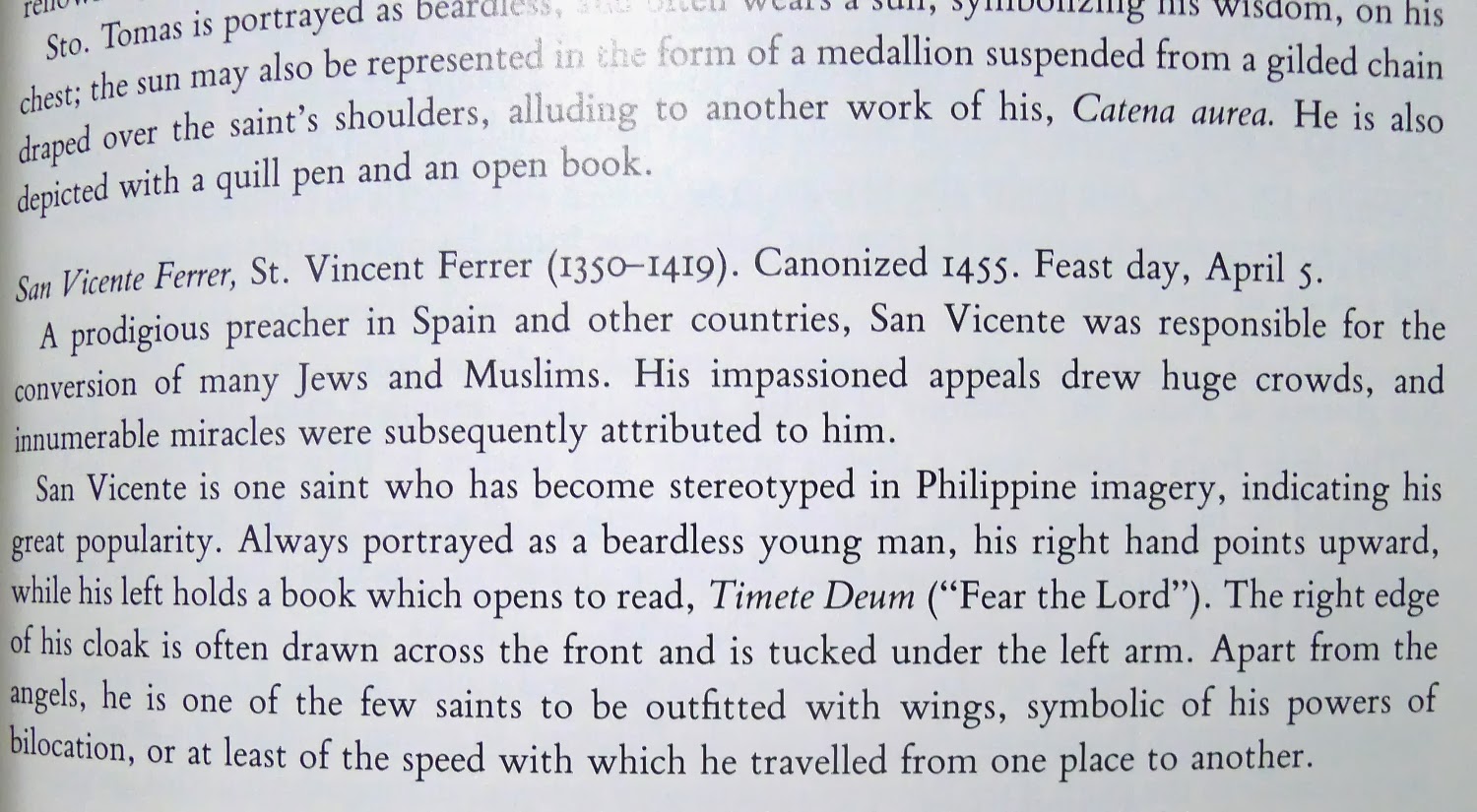
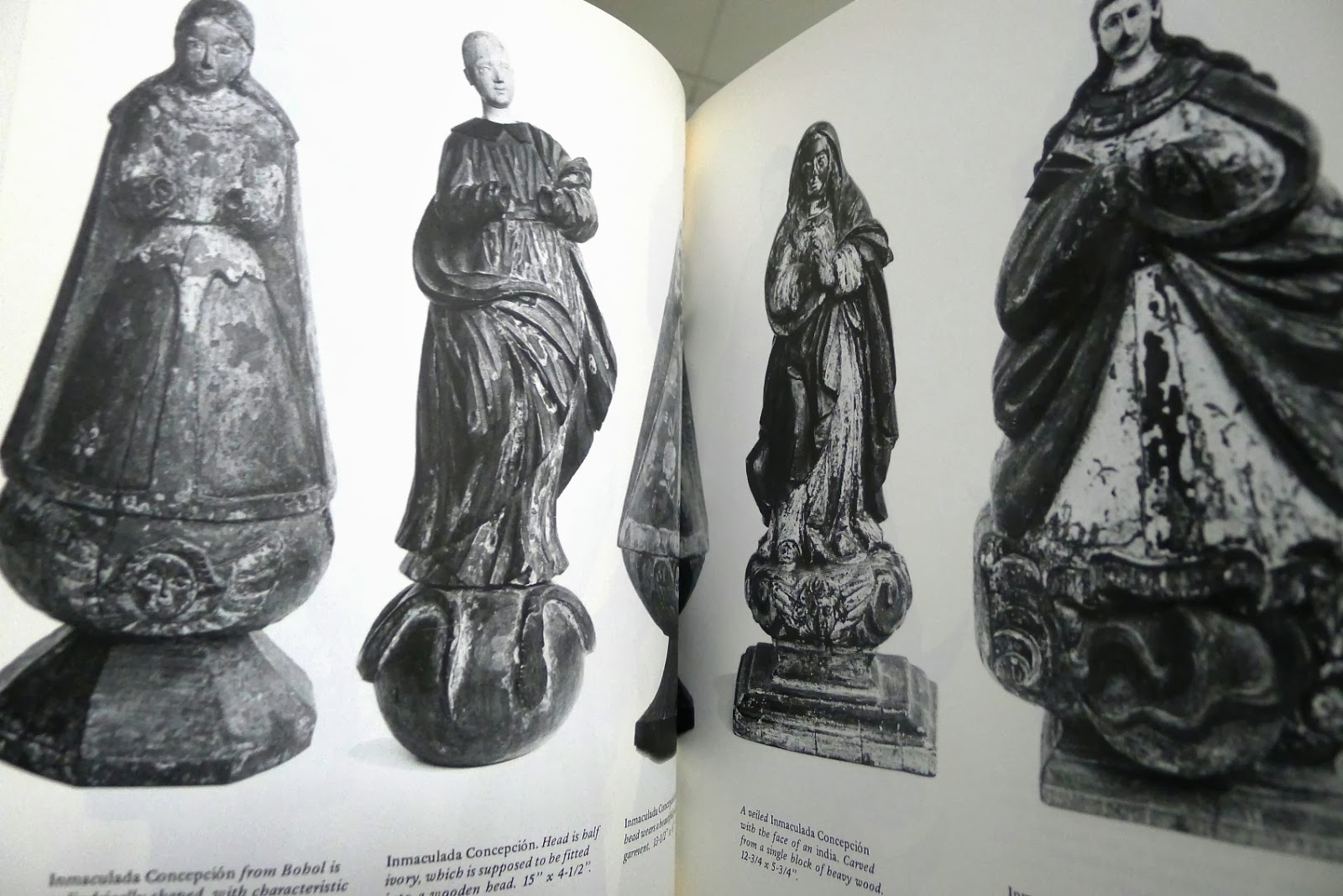
I simply love Esperanza B. Gatbonton's A Heritage of Saints: Colonial santos in the Philippines.  It's richly textured without sounding like a dissertation paper. And her collector's passion in her words is tempered by the need to elaborate and organize the different saints and relics that abound in the Philippines.  This was published during the heyday of the 70s wherein religious antiques of great quality still can be found in the shops along Mabini and del Pilar.  So, it is safe to say that this book is a product of the madness of antiquing during this period. Now, you would be consider lucky if you can find cheap yet authentic ivory pieces in the shops.


The book first delves into the history of the Filipino santos and the cult that it has spawned. From the conversion of the native heathens to Catholicism to the refashioning of the idols into household saints, it proves that our form of Christianity is still a part of our precolonial temperament.  She also talks about the art and craftsmanship of the santero or saint-maker and also the specific saint types like San Roque (St. Roche) to San Vicente (St. Vincent). Her writing is vivid yet rich with details. More importantly, the pictures are there to remind you that your santos in the sala may or may not be the real thing. And those in the photos are those pieces that may have gotten away.


Books (unlike catalogs) specifically on antique santoses/saints are really scant and rare. So far I have two out of the three better known works devoted to Philippine santos thanks mainly to the convenience of the web.  I am still searching for a reasonably priced Fernando Zobel de Ayala's Philippine Religious Imagery (Ateneo de Manila Univ., 1963). A diligent search in the net is a must if you're truly passionate in collecting antiques. Not just for the objects but the books that delve into the subject.  And Mrs. Gatbonton's book is a treasure indeed. And procuring one in near-mint condition is joyous indeed.

Book 01: Oriental Ceramics Discovered in the Philippines


If there’s a book that every Filipino ceramic collector should have in his/her library, this is the one. This is one of the earliest and most cited work when it comes to ceramics and Philippine terrestrial archaeology.  

Written during the plentiful year of the 60s by famed artist-archaeologist Leandro Locsin, Oriental Ceramics traces the origins of the trade, the history and the variety that they unearthed in Sta. Ana and Calatagan.  Aided by Robert Fox and the National Museum, Locsin has managed to systematically study and catalog early trade ceramics in a way that gives us a clear glimpse of the richness of precolonial Philippine society.  Presently, there has not been a book of this magnitude and scale ever published. Even the famed author on Asian ceramics, Roxanna Brown, acknowledged in her book The Ming Gap and Shipwreck Ceramics in Southeast Asia (The Siam Society, 2009) that the Sta. Ana and Calatagan finds were important because they constitute large burial finds that do not have a single Chinese blue&white ceramic. 

Published by Tuttle in Japan in 1967, Oriental Ceramics has the marks of being a collector's book. Hardbound in a blue buckram cover with gilded lettering, the volume is worth the $22.50 retail price. The paper used was heavy glossy paper similar to those mid-century US encylopedias we have in the house.  There are 228 plates and 89 in full color. Color printing back then must have commanded a premium price.  The photos are crisp and well lighted.  For collectors, the pieces featured inside are great reference to cross-check any collection.  Mostly, the pieces are Thai, Vietnamese or southern Chinese. If you're looking for Ming, you might want to check another book.
 

Famed historian Ambeth Ocampo collected and sold this volume. He recounted in the September 2006 newsletter of the Oriental Ceramic Society of the Philippines:

" I was so disinterested in ceramics that I sold two copies of the rare book, Oriental Ceramics Discovered in the Philippines by Leandro and Cecila Locsin. When I got hold of a third and fourth copy in 1999 and actually leafed through them, I realized very late that any study of Philippine pre-history inevitably touched on ceramics. These were so important that the pioneering pre-historian H. Otley Beyer even wrote an article on ‘The Philippines in the Porcelain Age’ (roughly the 9th to the 16th centuries). ... The more I read, the more interested I became and when I went into antique shops, I would give ceramics a second look and realize that they were objets d’art and not just traces of our history."

This is why if you are absolutely serious about collecting antique ceramics in the Philippines, then try to procure this book.